Your customer acquisition cost isn’t the problem.
It’s the symptom.
One of the first questions founders ask me is:
“How do we reduce our CAC?”
It’s a fair question. Rising advertising costs, increasing competition and changing consumer behaviour mean acquiring new customers is becoming more expensive almost every year.
But here’s what I’ve learnt after working with startups, scale-ups and established brands.
The businesses that obsess over reducing CAC often end up making decisions that damage long-term growth.
They slash advertising budgets.
Pause creative testing.
Stop investing in brand.
Target only existing high-converting audiences.
On paper, CAC falls.
In reality, future growth stalls.
A lower CAC isn’t the objective.
Profitable, sustainable growth is.
That’s why whenever I join a business as a Fractional CMO, I rarely start by looking at the advertising account.
Instead, I look at the entire commercial system.
Because CAC is usually the output of dozens of interconnected decisions—not just your media buying.
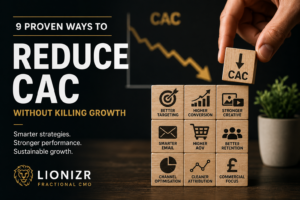
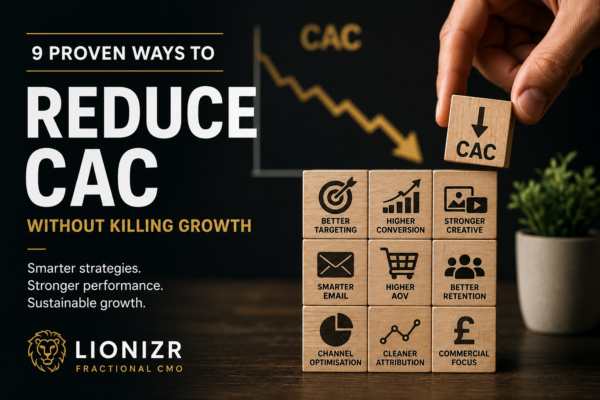
Here are the nine areas I review first.
1. Improve Your Conversion Rate Before Increasing Budget
This is the quickest win I see.
Many businesses try to solve growth problems by buying more traffic.
But if your website converts at 1.5%, doubling your advertising budget simply doubles the number of visitors leaving without buying.
Before increasing spend, ask yourself:
- Is the value proposition immediately clear?
- Can visitors understand the product within five seconds?
- Is the page cluttered?
- Are trust signals visible?
- Is checkout friction-free?
- Is mobile genuinely easy to use?
Even relatively small improvements in conversion rate can dramatically reduce acquisition costs because you’re generating more customers from the same advertising spend.
The cheapest customer you’ll ever acquire is the visitor who’s already on your website.
2. Stop Optimising Channels in Isolation
One of the biggest mistakes I see is channel optimisation without commercial optimisation.
The paid media team wants a lower CPA.
CRM wants higher open rates.
SEO wants more traffic.
Social wants more engagement.
Everyone is hitting their own KPIs.
Yet revenue barely moves.
Marketing channels don’t exist independently.
They’re part of one customer journey.
If paid media improves but your email programme fails to convert first-time buyers into repeat customers, CAC becomes increasingly difficult to sustain.
Optimise the system – not individual channels.
3. Invest More in Creative Than Campaign Tweaks
I’ve seen businesses spend weeks debating audience targeting while using the same creative for six months.
Creative fatigue quietly pushes CAC higher.
Consumers stop noticing your ads.
Click-through rates decline.
CPMs rise.
Performance falls.
Instead of endlessly adjusting campaign settings, invest in producing new creative that tests:
- different hooks
- different formats
- different offers
- different messaging
- different proof points
Creative is often the biggest lever available to performance marketers.
4. Improve Your First-Time Customer Experience
Reducing CAC isn’t just about acquiring customers.
It’s about increasing the value of every customer you acquire.
The better the first purchase experience, the more likely customers are to return, recommend your brand and increase their lifetime value.
That allows you to spend more confidently on acquisition while maintaining profitability.
Think beyond the transaction.
Consider onboarding.
Packaging.
Email flows.
Education.
Support.
These all influence acquisition efficiency more than many businesses realise.
5. Understand Where Customers Actually Come From
Attribution has never been more complicated.
GA4.
Meta.
Google Ads.
Triple Whale.
Northbeam.
Each platform tells a slightly different story.
Rather than chasing perfect attribution, focus on understanding trends.
Which channels consistently introduce new customers?
Which channels assist conversions?
Which channels influence repeat purchase?
Good attribution isn’t about finding one “correct” number.
It’s about making better commercial decisions.
6. Increase Average Order Value
Many businesses try to reduce CAC when they could simply afford a higher one.
Increasing average order value changes the economics of acquisition overnight.
Opportunities include:
- bundles
- subscriptions
- complementary products
- free shipping thresholds
- volume discounts
- premium options
A customer spending £120 instead of £80 immediately makes acquisition significantly more efficient.
7. Segment Before Scaling
Not all customers are equally valuable.
Some convert quickly.
Some buy repeatedly.
Some never return.
Instead of treating every audience the same, identify your highest-value customer segments and allocate budget accordingly.
Scaling becomes much easier when you’re investing behind customers with the strongest lifetime value.
8. Align Marketing With Commercial Priorities
This is where marketing leadership becomes critical.
Marketing shouldn’t simply generate traffic.
It should support business objectives.
Every marketing activity should answer questions like:
- What commercial problem are we solving?
- Which metric actually matters?
- How will success be measured?
When marketing and commercial strategy become aligned, acquisition naturally becomes more efficient.
9. Think Beyond CAC
This is perhaps the most important lesson.
CAC on its own is a dangerous metric.
A business with a £120 CAC and exceptional customer retention may be far healthier than one with a £40 CAC and poor repeat purchase rates.
Always evaluate CAC alongside:
- Lifetime Value (LTV)
- Gross Margin
- Payback Period
- Retention
- Churn
- Contribution Margin
Looking at these metrics together gives you a far more accurate picture of marketing performance.
How I Approach CAC as a Fractional CMO
When I begin working with a new client, I almost never open Meta Ads Manager first.
Instead, I ask questions like:
- Is the proposition compelling enough?
- Are we attracting the right audience?
- Does the website convert?
- Is pricing helping or hurting?
- What happens after someone buys?
- Which channels genuinely drive profitable growth?
Only then do I start optimising campaigns.
Because in my experience, high CAC is rarely caused by one poor-performing ad.
It’s usually the result of several small inefficiencies across the customer journey.
Fix those, and acquisition costs often improve naturally.
From the Lion’s Den
- CAC is a business metric, not just a marketing metric.
- The cheapest customer is often the visitor you’ve already paid to attract.
- Better creative usually beats endless campaign optimisation.
- Measure profitability, not vanity metrics.
- Sustainable growth comes from improving the whole system—not just reducing advertising costs.
Final Thoughts
Reducing CAC isn’t about finding a clever optimisation hidden inside your advertising platform.
It’s about building a business that converts more visitors, retains more customers and extracts greater value from every marketing pound spent.
When those fundamentals are in place, lower acquisition costs become a natural outcome—not the objective itself.