If you’re reading this in August, you’re already behind.
That probably sounds ridiculous.
After all, the sun’s (hopefully) still shining, schools are on holiday, and Christmas feels a long way off.
But whenever I start working with a DTC or eCommerce brand, one of the first questions I ask around this time of year is:
“What’s your Christmas strategy?”
The response usually falls into one of two camps.
Either they have a campaign calendar that’s already taking shape…
Or they look slightly puzzled and tell me they’ll “start thinking about it in September.”
Unfortunately, by September, many of the biggest commercial decisions have already been made for you.
Because Christmas isn’t won by the businesses that create the best festive adverts.
It’s won by the businesses that plan the earliest.
The biggest mistake brands make
One of the biggest misconceptions about Christmas is believing it’s simply a marketing campaign.
It isn’t.
It’s a commercial programme that affects almost every part of the business.
Marketing is only one piece of the puzzle.
By the time your marketing team starts designing Christmas emails or creating Meta adverts, a huge amount of work should already have happened behind the scenes.
Questions like these should already have answers.
- What are we selling this Christmas?
- What’s different from last year?
- What’s our hero product?
- What’s our promotional strategy?
- Can operations cope with demand?
- Do we have enough stock?
- Is customer service prepared?
- What revenue are we targeting?
- What role does marketing need to play to achieve it?
If those questions aren’t answered early enough, marketing becomes reactive instead of strategic.
Every successful Christmas campaign starts with the offer
One thing I see repeatedly is businesses jumping straight into campaign planning.
They start discussing:
- Meta budgets
- Google Ads
- Email campaigns
- Influencer activity
- Social content
But they’ve skipped the most important question. ‘Why should someone buy from you this Christmas instead of anyone else?‘
That’s the question that shapes everything.
Sometimes the answer is a genuinely innovative new product. Sometimes it’s a limited-edition range, or a beautifully packaged gift bundle. It might be an irresistible subscription offer. Whatever it is, developing that proposition takes time and thinking about product development, packaging, photography, pricing, landing pages, merchandising, stock forecasting, etc.
None of that happens overnight. Which is exactly why I encourage clients to begin planning months before most people even mention Christmas.
Christmas is bigger than marketing
One of the biggest mindset shifts I try to introduce is this.
Marketing doesn’t create Christmas – it amplifies the commercial strategy.
If finance hasn’t agreed budgets…
If operations haven’t planned fulfilment…
If buying hasn’t secured stock…
If product hasn’t finalised the range…
Marketing can’t solve those problems. In fact, rushing marketing usually exposes them.
The best Christmas campaigns aren’t created by brilliant marketers working miracles in October. They’re created by businesses that aligned every department months earlier.
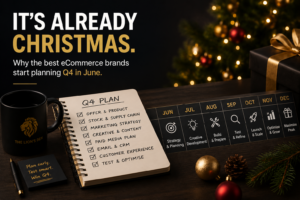
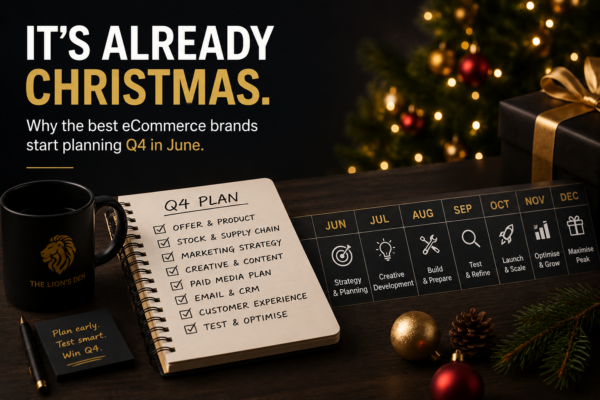
My Q4 planning timeline
Every business is different, but this is broadly how I like to approach Q4 planning.
June – Build the commercial plan
This is where the biggest strategic decisions are made.
- Revenue targets
- Sales forecasts
- Product strategy
- Promotional calendar
- Budget allocation
- Stock planning
- Resource planning
This is also the point where new product development or exclusive Christmas bundles need to be agreed.
July – Develop the campaign
With the commercial direction agreed, marketing can begin turning strategy into campaigns.
That means:
- Creative concepts
- Campaign messaging
- Photography
- Video production
- Packaging
- Landing page planning
- Email strategy
- Paid media strategy
Everything starts coming together.
August – Build and prepare
Now it’s time to execute.
Landing pages are developed.
Email automation is tested.
Creative assets are finalised.
Influencer partnerships are secured.
Media plans are refined.
Most importantly, there is still time to adjust if something isn’t working.
September – Test everything
This is where many businesses actually begin planning.
I’d rather be testing.
Testing:
- Offers
- Landing pages
- Creative
- Messaging
- Paid search campaigns
- Meta audiences
- Email subject lines
Testing now dramatically reduces risk later.
October – Launch
By October, the strategy shouldn’t still be under discussion.
Execution should already be underway.
The foundations have been built.
Now it’s about launching confidently.
November & December – Optimise
During peak trading, focus shifts.
Rather than creating everything from scratch, the priority becomes optimisation.
Monitor performance daily.
Adjust budgets.
Scale winning campaigns.
Respond quickly to demand.
Support operations.
Help customer service.
Keep the business aligned.
How I approach Q4
One thing founders often expect is that I’ll immediately start talking about advertising budgets.
Instead, the first conversation is usually much broader.
We’ll discuss commercial objectives.
Product strategy.
Profitability.
Operations.
Stock.
Customer behaviour.
Only once those foundations are in place do we start talking about Google, Meta, email or influencers.
Because marketing shouldn’t be deciding what Christmas looks like.
Marketing should be helping the business execute a clear commercial strategy.
From The Lion’s Den
- Christmas isn’t a marketing campaign.
- It’s a commercial strategy.
- Great offers take months to develop.
- Marketing should amplify the proposition, not invent it.
- October is too late for strategic planning.
- The brands that perform best at Christmas usually started preparing in June.
Final Thoughts
When people ask me why I encourage businesses to start planning Christmas in the summer, my answer is always the same.
Because by the time customers see your Christmas campaign, the hard work should already be finished.
The offer should be built.
The products should be ready.
The campaigns should have been tested.
The teams should know the plan.
Marketing then has the easiest job of all.
Helping a great strategy reach the people it was designed for.