Most businesses don’t have a paid search problem.
They have a budgeting problem. One of the first things I ask when reviewing a Google Ads account isn’t –“What’s your ROAS?” It’s much simpler.
“How did you decide where your budget should go?”
More often than not, the answer is surprisingly vague. Someone increased the spend because sales dipped. An agency shifted budget into Performance Max because Google recommended it. Brand campaigns have always received 20%. Shopping gets whatever is left.
The budget evolves over time rather than being deliberately planned. That’s understandable. Paid search changes constantly. But if your budget allocation isn’t driven by commercial priorities, you’re unlikely to get the best return from your investment.
The goal isn’t to spend more. It’s to spend smarter.
Budget allocation starts with the business, not Google Ads
One mistake I see regularly is businesses trying to optimise Google Ads before deciding what success actually looks like.
Ask yourself:
- Are you trying to maximise profit?
- Acquire new customers?
- Increase market share?
- Launch a new product?
- Protect existing demand?
Each objective requires a different budget strategy.
For example, a mature eCommerce business focused on profitability will allocate budget very differently from a startup trying to acquire customers as quickly as possible.
Before touching campaign budgets, define what the business is trying to achieve.
Understand your search demand
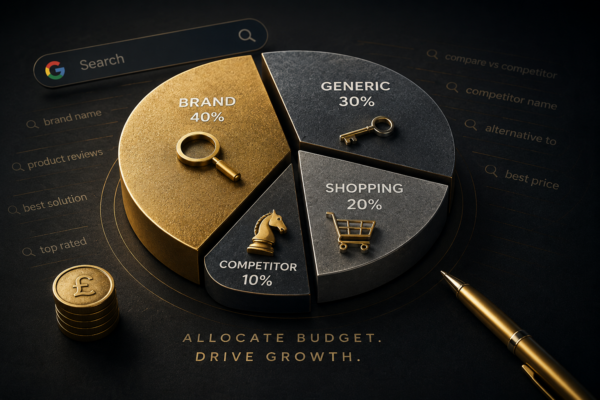
Not all searches have the same value. I tend to think about paid search in four broad categories: brand, generic, competitor and high-intent long tail. Rather than deciding percentages first, understand the commercial role each category plays.
1. Brand
People are already looking for you. These searches are often your cheapest conversions, so protect this traffic.
2. Generic
People are looking for solutions rather than brands.
Generally, a much higher volume, but with lots of competition. This is often the biggest growth opportunity.
3. Competitor
People searching for your competitors.
Can sometimes work well. Especially in price-sensitive markets.
However, this will be the most expensive, so it needs careful planning and testing.
4. High-intent long-tail
Specific searches with strong buying intent. Each individual search is much lower in volume. But add all of these searches together, and it will likely be the largest category, with the highest conversion rates. Yet, this is an area often overlooked.
Don’t allocate budget equally
Equal budgets rarely produce equal returns.
Instead ask yourself where is the next profitable customer most likely to come from?
Sometimes that’s Shopping or Brand. It could be Performance Max. Sometimes it’s reducing spend altogether. Budget should follow opportunity.
Not habit.
Think marginal returns, not average returns
This is probably the biggest mindset shift.
Imagine your Brand campaign delivers a ROAS of 7 – great!
Should you double the budget? Not necessarily, as you’ve probably already captured most of the available demand, and the next £1,000 in spend may generate a much lower return.
Instead, ask yourself, Where will the next £1 generate the biggest commercial return?
That’s how budget decisions should be made.
Separate testing from scaling
One mistake businesses make is expecting every campaign to perform immediately. I prefer separating budgets into two pots.
1. Scaling budget
The campaigns already producing predictable results.
Approximately 80-90%.
2. Testing budget
Without experimentation, paid search eventually plateaus – New keywords, landing pages, creative, campaign types, etc.
Approximately 10-20%.
Don’t ignore conversion rate
Businesses often increase Google Ads budgets while leaving their website untouched.
If your conversion rate improves from 2% to 3%, you’ve effectively increased the efficiency of every advertising pound.
Before increasing spend, ask:
- Can landing pages improve?
- Can checkout improve?
- Can product pages convert better?
- Is messaging clear?
The website deserves just as much attention as the campaigns themself.
Measure beyond ROAS
ROAS is useful – but it isn’t enough.
I also review:
- Customer Acquisition Cost (CAC)
- Gross Margin
- Lifetime Value
- New vs Returning Customers
- Profit Contribution
- Incremental Revenue
Sometimes the campaign with the lower ROAS is actually creating more long-term value.
Review budgets regularly
Markets change, competitors change, consumer behaviour changes, and there are seasonality changes too.
Your budget allocation should evolve too.
I typically recommend reviewing budget allocation monthly and carrying out a deeper strategic review every quarter.
How I Approach Paid Search Budget Allocation
When I join a business, one thing surprises many founders – I rarely open Google Ads first.
Instead I ask questions like:
- What’s the commercial objective?
- Which products are most profitable?
- Where is growth expected?
- What’s limiting conversion?
- How much demand already exists?
Only then do I decide how paid search should support those objectives. Google Ads isn’t the strategy. It’s one of the tools used to execute it.
From the Lion’s Den
- Don’t let Google decide your marketing budget.
- Budget should follow commercial opportunity, not historical spend.
- The next £1 matters more than the last £1.
- Test continuously, but scale with confidence.
- Paid search works best when aligned with business strategy.
Final Thoughts
There isn’t a perfect paid search budget allocation. Every business is different.
The most successful brands don’t ask: “How much should we spend on Google Ads?”
They ask: “Where should the next pound go to generate the greatest commercial return?”
That’s a much better question. And it usually leads to much better marketing decisions.